
Amal Trade Developers
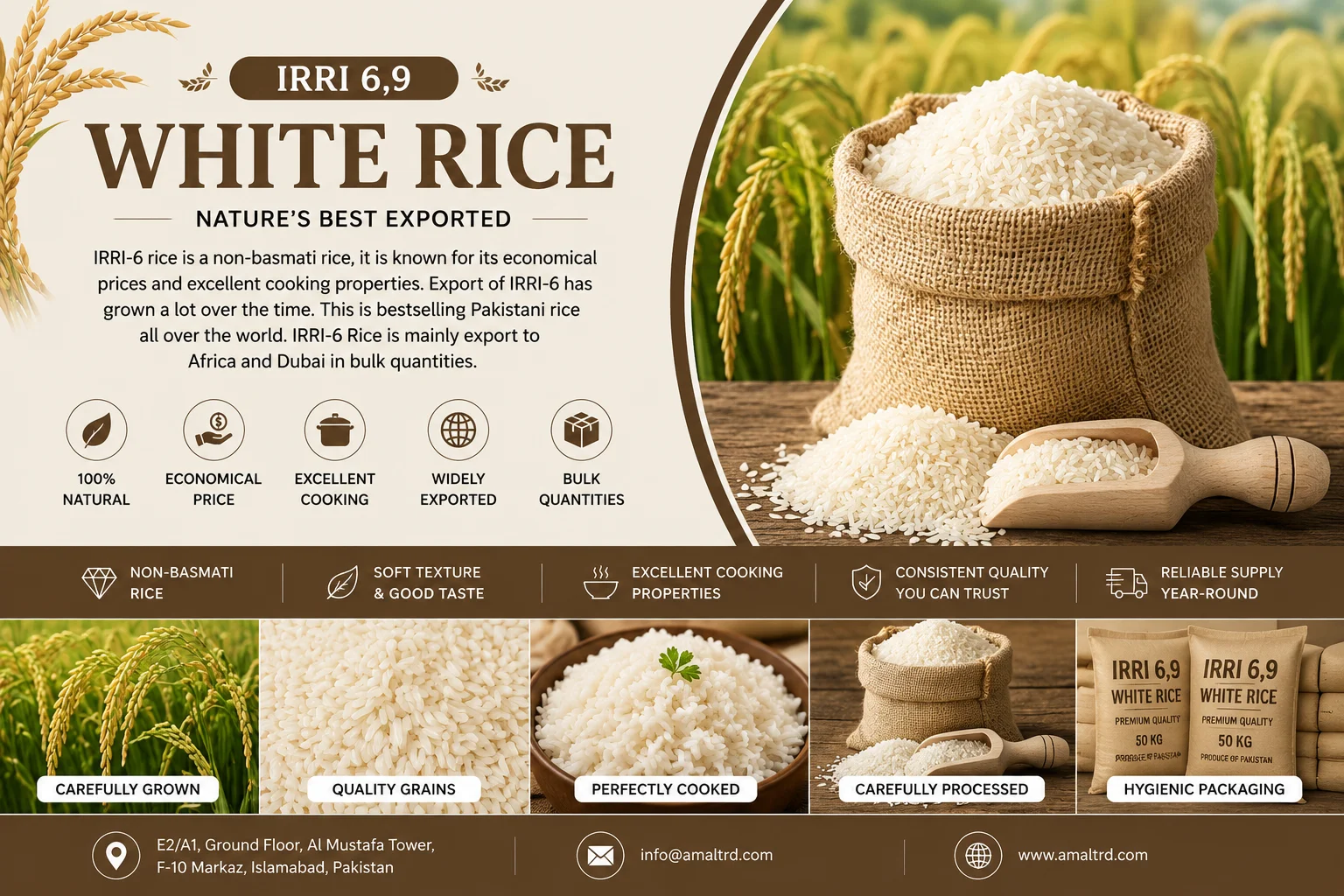
IRRI-6 and IRRI-9 are Pakistan's principal long-grain non-basmati white rice varieties — the workhorse lines behind institutional catering, food-aid tenders, food processing, and high-volume retail programmes. Amal Trade supplies both in white and parboiled forms across the full broken range from 5% to 100%, milled, graded, sortexed, and packed to buyer specification for importers, wholesalers, and bulk commercial buyers worldwide.

Why non-basmati white rice, not basmati, carries the world's institutional and food-aid tonnage.
IRRI-6 and IRRI-9 are long-grain white rice varieties bred for yield and consistency rather than aroma. That is precisely why they dominate bulk trade: a buyer feeding a school system, a labour camp, or a relief programme needs predictable cost per tonne and predictable cooking behaviour — not fragrance. These varieties deliver both, at a fraction of basmati pricing.
The two are closely related and often quoted together. In practice IRRI-6 is the higher-volume line with slightly softer cooking, while IRRI-9 tends to hold a marginally firmer grain that some parboiling buyers prefer. Both cook soft and fluffy, absorb liquid readily, and suit dishes where rice is the base rather than the feature.
The commercial variable that matters most here is broken percentage, not variety. Grades run from 5% broken at the premium end down through 10%, 15%, and 25%, to 100% broken used in brewing, snack manufacture, and rice flour. Amal Trade supplies the full range in both white and parboiled forms under our ISO 9001:2015 quality system. Buyers stocking aromatic lines alongside this may also want to review our PK-386 basmati or the complete rice export range.
What bulk buyers actually optimise for when aroma is not part of the specification.
Non-basmati pricing makes large feeding programmes, institutional contracts, and value retail lines commercially viable at scale.
Uniform milling and consistent grade mean the same water ratio and the same yield batch after batch — critical in kitchens cooking hundreds of portions daily.
Pakistan's largest rice crop by tonnage, so supply holds through the year and repeat container programmes can be planned with confidence.
The channels that move non-basmati white rice in container volumes.
Labour camps, hospitals, schools, and canteens where cost per portion and consistency outrank aroma.
Relief and government tender supply, where documented grades and reliable tonnage are the requirement.
Higher broken grades and 100% broken feed rice flour milling, snack manufacture, and brewing inputs.
Everyday consumer packs and 50 kg bulk bags for distributor and wholesale programmes.
Broken content is the main price and specification variable in non-basmati rice. Lower broken means more whole grains and a higher price; higher broken suits processing and cost-driven programmes.
A complete specification at enquiry stage means a firm, accurate quotation the same working week.
Broken content in commercial rice is a contractual tolerance, not an exact figure — a 5% grade means broken content up to 5%, measured on an agreed sampling method, and every lot carries natural variation around that limit. Because pricing moves sharply with this figure, we recommend that the grade, sampling method, and inspection party are fixed in writing before shipment, and that first-time buyers approve a pre-shipment sample against the stated grade.
The points bulk buyers raise most often before placing a first order.
Both are long-grain non-basmati white rice varieties from Pakistan and are close substitutes. IRRI-6 is the higher-volume line with slightly softer cooking; IRRI-9 tends to hold a marginally firmer grain, which some parboiling buyers prefer. Many contracts are quoted as IRRI 6/9 for either.
5% and 10% suit retail packs and quality-sensitive catering. 15% and 25% are the usual choice for institutional feeding and food-aid programmes where cost per tonne leads. 100% broken is a processing input for rice flour, snacks, and brewing.
Basmati varieties like PK-386 and Kainaat 1121 offer aroma, grain length, and elongation at a significantly higher price. IRRI 6/9 has no aroma claim — it competes on cost, consistency, and availability, which is what bulk and institutional programmes are specified around.
White rice is milled directly from paddy and cooks softer. Parboiled rice is steam-treated before milling, giving firmer separate grains, lower breakage in transit and cooking, and better nutrient retention — often preferred for African and Middle Eastern markets.
One full container load is standard — approximately 25 to 27 metric tonnes depending on packing format and container type. For repeat programmes we can plan monthly or quarterly shipment schedules against a framework contract.
Yes. We regularly supply against institutional and government tender specifications, including nominated third-party inspection, specified sampling protocols, and any additional certification the tender requires.
Share your required variety, form, broken grade, packing size, and destination port — we will respond with availability, specifications, and export pricing for one-time or contract supply.